War updates: Escalating : A Region on the Brink
Reaction from the field
The ongoing conflict in the Middle East has reached a critical juncture, with significant implications for regional stability and global oil supplies. As the war, which began on February 28, 2026, enters its fourth week, the death toll has surpassed 2,000 lives. This alarming statistic underscores the dire humanitarian impact of the hostilities, which have drawn in multiple actors, including Iran, Israel, and the United States.
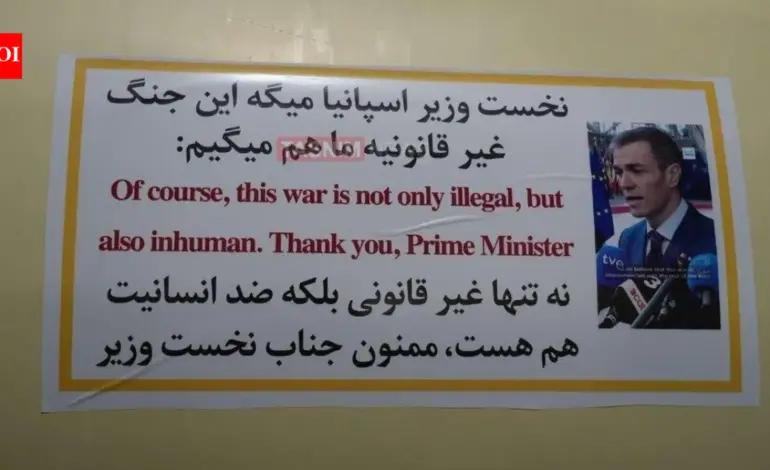
Recent developments have escalated tensions further. Notably, Iran has attached Spanish Prime Minister Pedro Sanchez’s anti-war remarks to missiles aimed at Israel, a provocative act that signals Tehran’s willingness to escalate its rhetoric and military posturing. Sanchez’s comments, labeling the war as “illegal and inhuman,” have seemingly been weaponized by Iran to bolster its narrative against Israel.
In a related move, Iran’s Parliament Speaker, Mohammad Bagher Ghalibaf, issued a stark warning: any attack on Iranian power plants would lead to the destruction of vital infrastructure across the region. This threat highlights the precarious nature of the conflict, as Iran’s Islamic Revolutionary Guard Corps has indicated it would shut the Strait of Hormuz—a crucial waterway through which 20 percent of global oil supplies transit—if U.S. threats are executed.
On the ground, the Israeli military is ramping up its operations against Hezbollah in Lebanon, with Lieutenant General Eyal Zamir stating, “The operation against the Hezbollah terrorist organization has only begun. This is a prolonged operation.” This statement reflects Israel’s commitment to intensifying its military efforts, potentially leading to further casualties and regional destabilization.
Hezbollah’s recent rocket attack in Lebanon resulted in one death, illustrating the ongoing violence and its impact on civilian populations. Meanwhile, Kataeb Hezbollah has extended a pause on attacks against the U.S. embassy in Baghdad by five days, a decision that may indicate a strategic recalibration amid the escalating conflict.
The situation remains fluid, with uncertainties surrounding the potential for broader international involvement. Israeli Prime Minister Netanyahu has called for increased global engagement in the war against Iran, suggesting that the conflict could expand beyond its current borders, drawing in more nations and complicating the geopolitical landscape.
As the conflict continues to unfold, the stakes are high. The potential closure of the Strait of Hormuz could have catastrophic consequences for global energy markets, and the humanitarian crisis is likely to deepen if hostilities persist. With both sides entrenched in their positions, the prospect for a peaceful resolution appears increasingly distant. Details remain unconfirmed regarding the next steps from both Iran and Israel, leaving the region in a state of heightened uncertainty.