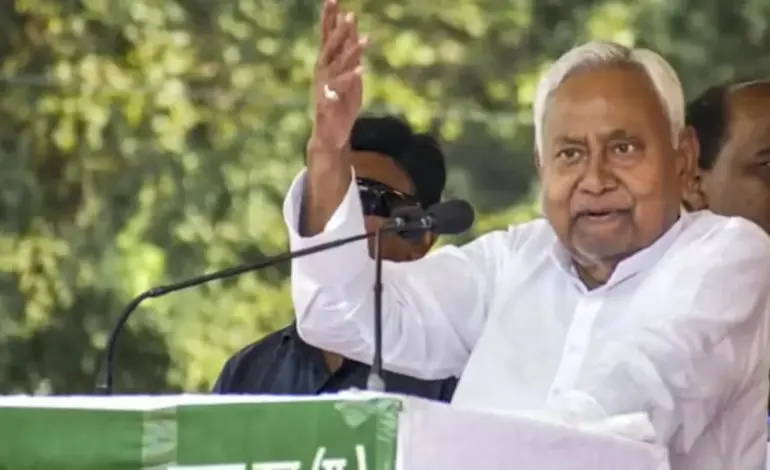
Bihar cm nitish kumar
Significant Political Shift in Bihar
Bihar Chief Minister Nitish Kumar has announced his candidacy for the upcoming Rajya Sabha elections, marking a pivotal moment in the state’s political landscape. After serving as Chief Minister for over two decades, Kumar’s decision to step down from this role signals a significant transition in Bihar’s governance and political dynamics.
Nitish Kumar’s tenure has been characterized by a focus on infrastructure development and social welfare, garnering him considerable support among the populace. His governance model has been instrumental in shaping Bihar’s development narrative, as he stated, “Bihar today is presenting a new dimension of development and dignity because of the confidence shown by the people.” However, his departure from the Chief Minister’s office opens a new phase in Bihar’s politics, with the Bharatiya Janata Party (BJP) likely to nominate a successor.
In the 2025 Bihar Assembly elections, the National Democratic Alliance (NDA) secured a significant victory, winning 202 out of 243 seats, with the BJP emerging as the single largest party, claiming 89 seats, while Kumar’s Janata Dal (United) (JD(U)) won 85 seats. This electoral success has set the stage for Kumar’s transition to the Rajya Sabha, where he filed his nomination on March 5, 2026.
Political Alliances
Kumar’s political career has seen him oscillate between alliances with both the BJP and the Congress-led opposition, reflecting a complex relationship with the state’s political factions. His decision to move to the Rajya Sabha is viewed by some as a strategic maneuver rather than a complete withdrawal from politics. As one observer noted, “His decision to move to Rajya Sabha clearly shows that he is not giving up politics but only stepping away from the Bihar politics.”
Challenges Ahead for JD(U)
The transition raises questions about the future of the JD(U) without Kumar at the helm. Some party workers have expressed concerns, with protests emerging against his potential move to the Rajya Sabha. Observers suggest that without Kumar’s leadership, the JD(U) may struggle to maintain its independent identity within the alliance. As one analyst remarked, “Without Kumar at the helm in Patna, the JD (U) may struggle to maintain its independent identity within the alliance.”
Long-Term Implications
Kumar’s departure aligns with a broader pattern of political evolution in Bihar, particularly in relation to the BJP’s growth over the past four decades. This shift could have lasting implications for the state’s political landscape, as new leadership emerges and alliances are tested. The exact reasons for Kumar’s decision to step down remain unconfirmed, leaving room for speculation about the motivations behind this significant political move.
Future Developments
As Bihar enters this new chapter, the political community will be closely watching how the JD(U) adapts to the absence of its long-time leader. The uncertainties surrounding Kumar’s decision and the party’s future direction will be critical in shaping the state’s political narrative in the coming months. Details remain unconfirmed regarding the full implications of this transition, but it is clear that Bihar’s political scene is poised for change.